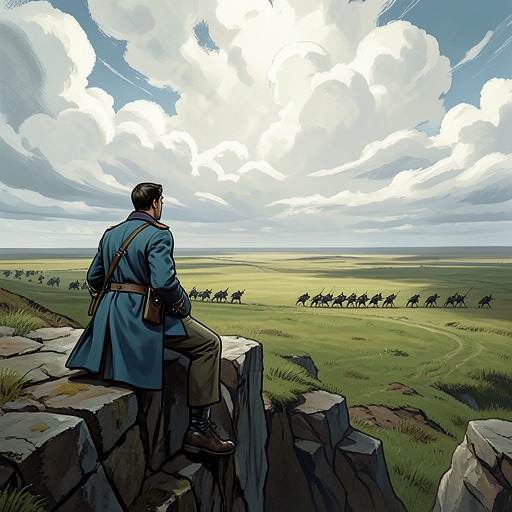
There is no greatness where there is no simplicity, goodness, and truth
War and Peace“There is no greatness where there is no simplicity, goodness, and truth” is a moral and interpretive maxim directed against the historical worship of power. It insists that greatness cannot be separated from goodness, truth, and the unadorned recognition of human responsibility; a reputation for genius cannot transform abandonment, atrocity, or self-serving myth into virtue.
The Maxim Against Heroic Exception
The principle emerges from an attack on historians who explain the French retreat from Russia as the expression of Napoleon Bonaparte’s superior will. Even movements that appear senseless—the retreat from Malo-Yaroslavets along a devastated road despite an open route toward a well-supplied district, and the later retreat from Smolensk to Orsha—are presented as the products of profound plans. The maxim exposes the moral cost of this method: historical reasoning becomes so elastic that it can convert any result into evidence of genius.
The same distortion is applied to Napoleon Bonaparte’s conduct at Krasnoe. Historians report that he was prepared to accept battle and take personal command, yet he soon fled again, leaving the scattered remnants of the army to their fate. His escape is then treated as an act characteristic of greatness rather than described in the ordinary moral language applied to anyone else. The principle therefore rejects the idea that fame suspends judgment. A celebrated leader remains responsible for what he does to the people he has brought into danger.
Greatness and Moral Judgment
The passage identifies the historians’ final refuge as the category of “greatness.” When actions plainly contradict what humanity recognizes as right or just, the historians are said to declare that greatness lies beyond such standards. Under this system, nothing is wrong for the “great” man, and no atrocity can be charged against him; the vocabulary of “grand” and “not grand” replaces the vocabulary of good and evil.
The maxim reverses that hierarchy. It denies that greatness is an independent scale capable of overruling right and wrong. To admit a greatness that cannot be measured by moral standards is, in the passage’s argument, to confess one’s own nothingness and meanness before power. The ethical standard must remain common and intelligible: simplicity, goodness, and truth are not decorative virtues added to greatness after the fact, but the conditions that make greatness real.
Rhetorical Force and Contrast
The expression gains force through sharp contrasts. Napoleon Bonaparte’s abandonment of the army is set against the historians’ elevated language; the warm fur coat in which he escapes is set against the men left to perish; and the ordinary shame attached to running away is set against the acclaim of “Napoleon le Grand.” The contrast reveals how grand rhetoric can conceal concrete suffering.
The passage also turns Napoleon Bonaparte’s own reflection that only one step separates the sublime from the ridiculous into an accusation against the culture of hero worship. The world repeats the labels “Sublime,” “Grand,” and “Napoleon le Grand,” while failing to ask whether the conduct beneath those labels possesses simplicity, goodness, and truth. The maxim interrupts that repetition by restoring the suppressed moral vocabulary.
Relation to the Book’s Historical Argument
As an expression, the maxim condenses the broader criticism of the “great man” theory of history. Historians attribute the movements of a mass army to the will of one individual and then reinterpret every contradiction as proof of hidden intelligence. Against this, the passage emphasizes the difference between a constructed explanation and the ethical reality of conduct. The more completely historical language protects a hero from blame, the more clearly it reveals the weakness of the theory that produced it.
The maxim also joins moral evaluation to historical truth. Simplicity means refusing elaborate explanations when events show confusion and collapse; goodness means refusing to praise actions that abandon human beings; truth means resisting the myths by which defeat and flight are renamed genius. Its significance is therefore both ethical and historiographical: it supplies a standard by which narratives of power can be tested, and it makes moral clarity a condition of truthful understanding.